Industry & Compliance
Reid Williams
COVID caused a surge in the creator economy. It felt like everyone was a creator all of a sudden - and the numbers support this. More than 165 million new creators joined social platforms between 2020 and 2025, increasing the total number of people creating content for some economic purpose to an estimated 225 million worldwide. Fans had already shown they were willing to pay creators directly with no product or content exchanged at all, sending money through Cash App, Venmo, and PayPal simply because they wanted to support someone. Gifting platforms did not invent this behavior. They packaged it, wrapping payments in a wishlist or a gift registry that made them feel more like gestures of support and not transactions. Those gifts came in two forms, physical products shipped directly to a creator or cash sent straight to them minus a platform fee.
Building products around this behavior seems safe on paper. A gift is not a purchased service. There is no expectation to deliver anything back to the gifter. The compliance posture looked light too, nothing like what a platform hosting actual content would face. If you call it a gift, the transaction disappears. A fan giving a gift is not the same as a fan paying for something, at least on the surface. That framing is comforting for the platform and comforting for the audience. It is also exactly what makes it nearly impossible for a processor or a bank to tell a real gift from payment for services rendered off platform.
The bank who sponsors a processor does not see a gift. Instead, they see a payment moving through payment rails it is legally responsible for, and it wants to know what that payment was actually for. This is the concern underneath everything else we’ll cover in this piece. Gifting platforms make it easy for a creator to receive money for services rendered off platform, prostitution included, and label it a “gift”.
This is not a hypothetical. a popular gifting platform was openly used by escorts to receive anonymous gifts from their clients. In early 2024, Stripe updated their prohibited and restricted list to include fetish services, cutting several platforms off from payment rails entirely.
Many of these platforms market themselves as creator friendly and explicitly welcome adult creators, and that distinction matters. A creator with an OnlyFans account is running a legal business. The concern has never been what kind of content a creator makes. The concern is what happens when a gift becomes payment for something off platform. The line that matters is prostitution, not adult content.
The better platforms draw that line in their terms. Solicitation is prohibited. The sale of sex is prohibited. Links to escort services are prohibited. Offering anything in exchange for a gift is prohibited. The rules exist because the platform recognizes the distinction between an adult creator and a transaction for prostitution, even when the payment itself gives you no way to tell the difference. As a result of these terms, online chatter from sex workers describes some of these platforms as “not SW friendly”.
So why does this matter?
Since 2018, federal law makes it a crime for anyone who owns or operates a platform with the intent to promote or facilitate prostitution. 18 U.S.C. § 2421A was written for exactly this, a platform used to arrange or monetize commercial sex, not just the person selling it.
There is also civil liability alongside the criminal exposure. Under the Victims of Trafficking and Violence Protection Act of 2000, a survivor can sue a platform that knowingly benefited from a trafficking venture, or should have known. A platform does not need to be the actual trafficker to be liable. It just needs to have looked the other way.
There is also the commercial risk, which moves faster than the federal or civil statues. Banks don’t wait for a lawsuit or a conviction, they move to de-risk the moment the pattern becomes evident. One policy update from Stripe and a platform can lose it’s rails entirely. This is detrimental for a business that is built entirely on receiving payments.
Once a platform is publicly tied to prostitution or trafficking, the scrutiny does not stop with one bank or one processor. Journalists notice, regulators notice, and every partner downstream starts asking the same question the bank already asked. The risk exists whether or not a platform has ever heard of Creator Shield. It starts the moment money moves and the platform cannot explain what it was actually for.
While building Creator Shield, we saw firsthand that terms on a page are not enforcement. Enforcement is a full-time job. It requires a system that runs continuously across every account. Terms of service describe a rulebook, but we found little to no evidence of systems consistently enforcing it. While running early versions of Creator Shield against creator accounts, we found thousands of direct references to a well known gifting platform on some of the largest escort directories. Profile URLs were embedded directly in escort pages, alongside Venmo handles and Cash App tags used to collect payment from clients.
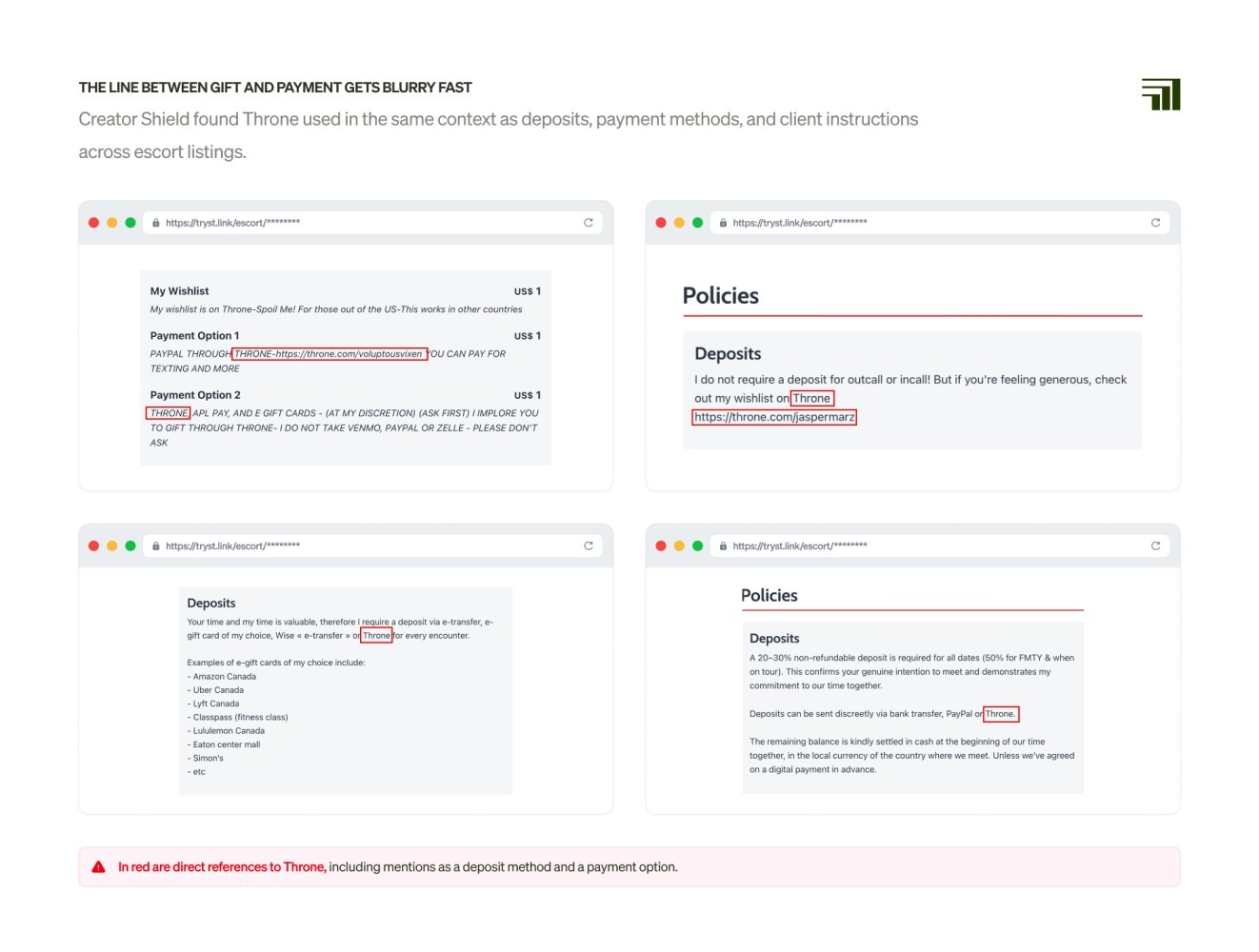
These were not stray mentions. They were active links sitting in plain view on a site built around the exact type of activity their own terms prohibit.
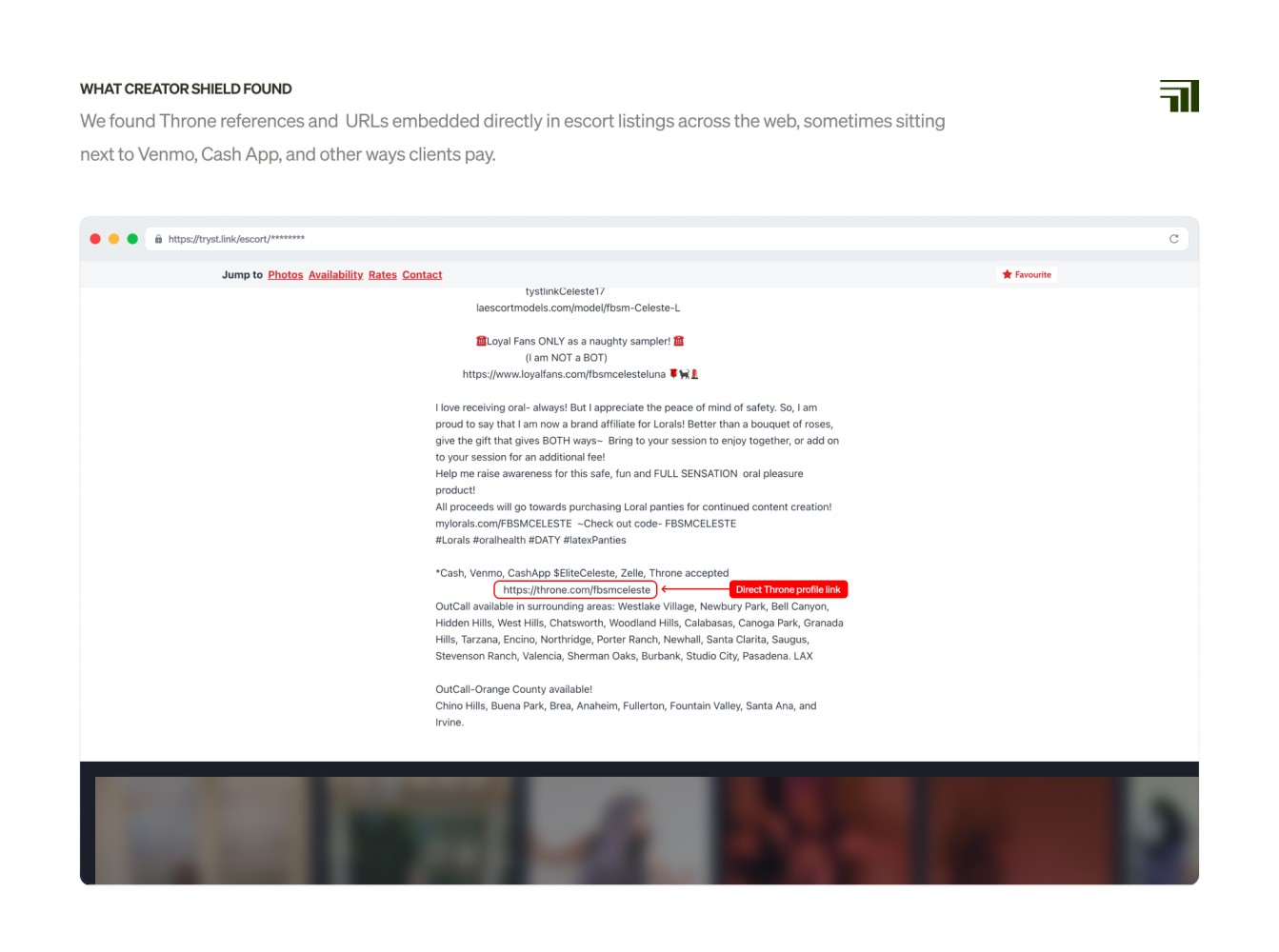
This is the gap Creator Shield closes. Throne can prohibit solicitation in its terms of service, but enforcing that rule every day across every creator requires a system built to find it.
During account creation, a platform sends Frame the data needed to verify KYC for that creator, alongside the profile URL of the creator on their own site. We validate the identity first, a name, an address, a real person confirmed to exist. That verified identity is the anchor for everything that follows. Creator Shield does not run against an unverified account, because a search is only as good as the identity it is searching for.
Once KYC is verified, we pull additional signals from the profile itself, like a stage name or display name, because almost no one is soliciting under their legal name. Creator Shield takes the verified identity and profile data together and goes searching.
Creator Shield started with us manually finding and cataloging known escort sites. I think some of our engineers are still explaining to their partners how this counted as “work.” That exercise quickly showed us the hard part was not searching, it was figuring out where to search next.
So we gave the agent the ability to search the web, follow references across directories, forums, and review sites, and continuously expand its own index. Today, Creator Shield crawls deeper into smaller and more niche corners of the internet as it discovers them. We’ve indexed more than 2,200 known escort directories.
We also built a separate agent to classify and rank those sites using their content and web traffic data. A match on a large, established directory should carry more weight than a match on an obscure site with almost no traffic. We route the work across a mix of models depending on the difficulty of the task. The hard part is not finding a name on the internet. It is deciding whether the source matters, whether the identity actually matches, and whether there is enough evidence for a platform to act on it.
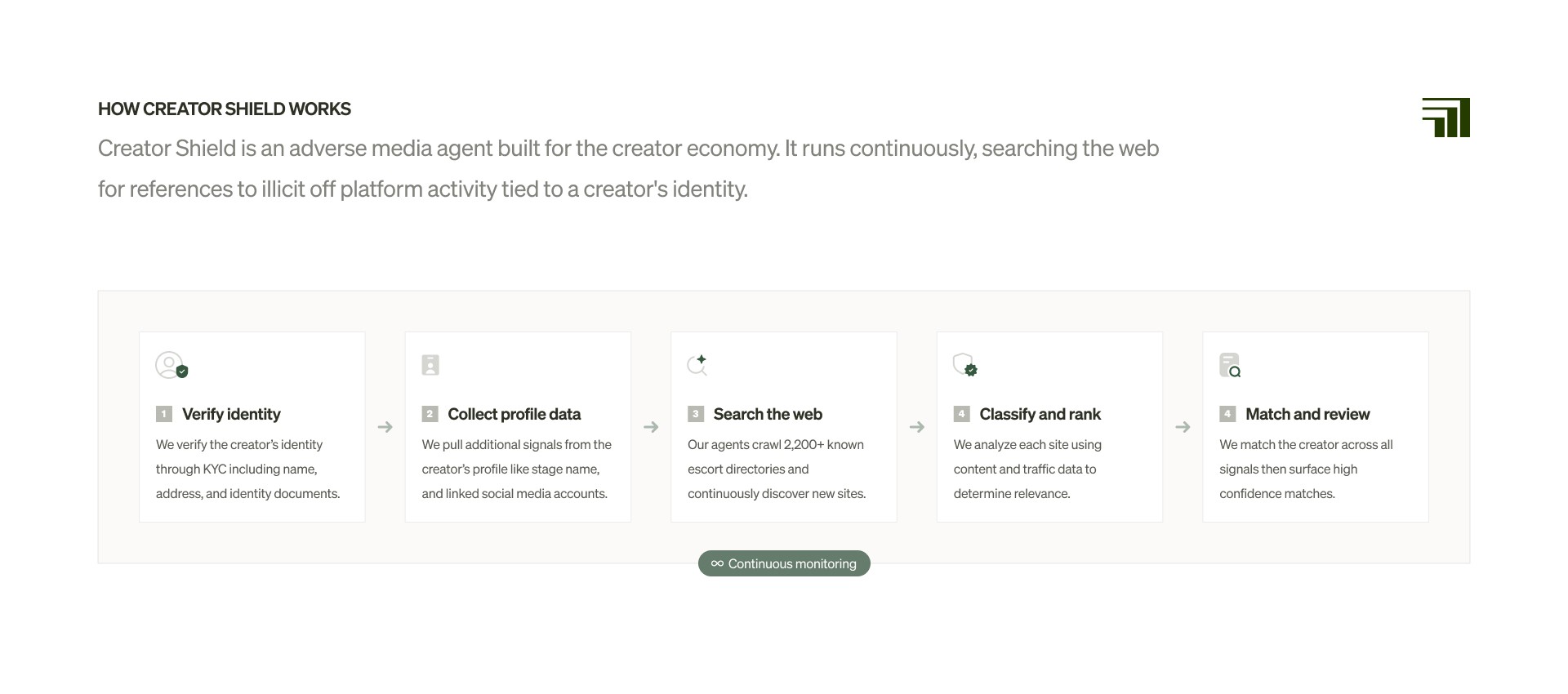
The goal is not to search the obvious places. It is to keep finding the places built specifically for this activity, including the ones most platforms would never know to look for.
The creator’s profile is just the starting point. From there we can often trace a creator across Instagram, Twitter, and other social platforms. We then cross reference photos through image comparison to confirm it is actually the same person showing up in an escort listing, not just a similar name or a coincidence. Creator Shield runs continuously, because a creator's activity off platform can start well after the day they were onboarded.
False positives happen. A fake profile using a creator’s photos without their knowledge is a real risk with any index this large, and Creator Shield is built to account for that. When a creator is misidentified, we send that information back to the platform so they can dispute the match and trigger a DMCA takedown against the fake listing. In that case, the false positive becomes useful. It helps protect the creator, not just the platform.
This is Frame in action. Compliance infrastructure that enables money movement.
A platform’s terms are only as real as the system enforcing them. Creator Shield is the clearest example of what that looks like in practice. It takes a rule that exists on paper and turns it into something a platform can actually act on before their processor finds it, before the network finds it, and before it becomes a platform problem.
If you’re running a creator platform and you think this kind of monitoring matters, we should probably talk.
Reid Williams
Risk Analyst, Frame
Reid Williams is a Risk Analyst at Frame, where he works on Creator Shield and the risk systems that keep creator platforms on payment rails.
Discover how Frame can help your business.
Book a call